Now that I’ve lived in Spain for over a year, I constantly hear a steady stream of little “extra” words that seem to pop up in every conversation, especially: venga, vale, anda. I understood “venga” to mean “come” (from the verb “venir”), so I wasn’t sure why everyone was always yelling at everyone else to “Come here!”
They aren’t doing that.
As I’ve been learning in my online Spanish classes, these little words like “venga” are discourse markers: short words or phrases that don’t add much new information to the sentence, but do a ton of work for the conversation. They guide how what you’re saying should be understood. For example, they can:
- Show agreement (vale)
- Soften a disagreement (bueno…)
- Buy you a second while you think (a ver…)
- Signal a transition (pues)
- Emphasize disbelief (venga ya)
- Mark a reaction as surprise or disbelief (¡anda!)
In other words, discourse markers are the conversational traffic signals of Spanish—less about content and more about flow.
And they’re everywhere in Spain for a simple reason: they’re incredibly useful. Castilian Spanish is often spoken quickly, with lots of overlap, interruptions and constant negotiation of tone—friendly, teasing, skeptical, emphatic, polite, blunt (sometimes all in one minute).
Discourse markers help speakers manage that moment-to-moment social choreography without having to spell everything out. They keep the rhythm natural, show what you mean between the lines, and make your speech sound less like a textbook and more like an actual human being.
So if you’re learning Spanish and you’ve been confused by (or just ignoring) these “little words,” I’ll give you three discourse marker cheat sheets:
- ¡Venga! Spanish Discourse Markers (part 1 — this one)
- ¡Vale! Spanish Discourse Markers (part 2)
- ¡Anda! Spanish Discourse Markers (part 3)
Example Conversation with Discourse Marker Venga
First, here’s a taste of how a natural (not text-book) Spanish conversation using the discourse marker “venga” looks:
- —Lucía: Tenemos diez minutos. Venga, mete eso en la mochila.
- —Dani: Ya voy, ya voy.
- —Lucía: Venga, a ver… ¿llaves, cartera, móvil?
- —Dani: Sí… bueno, el móvil… espera.
- —Lucía: ¡Venga ya! Si lo tenías hace un segundo.
- —Dani: Aquí está, aquí está.
- —Lucía: Venga, al lío: bajamos y pillamos el metro.
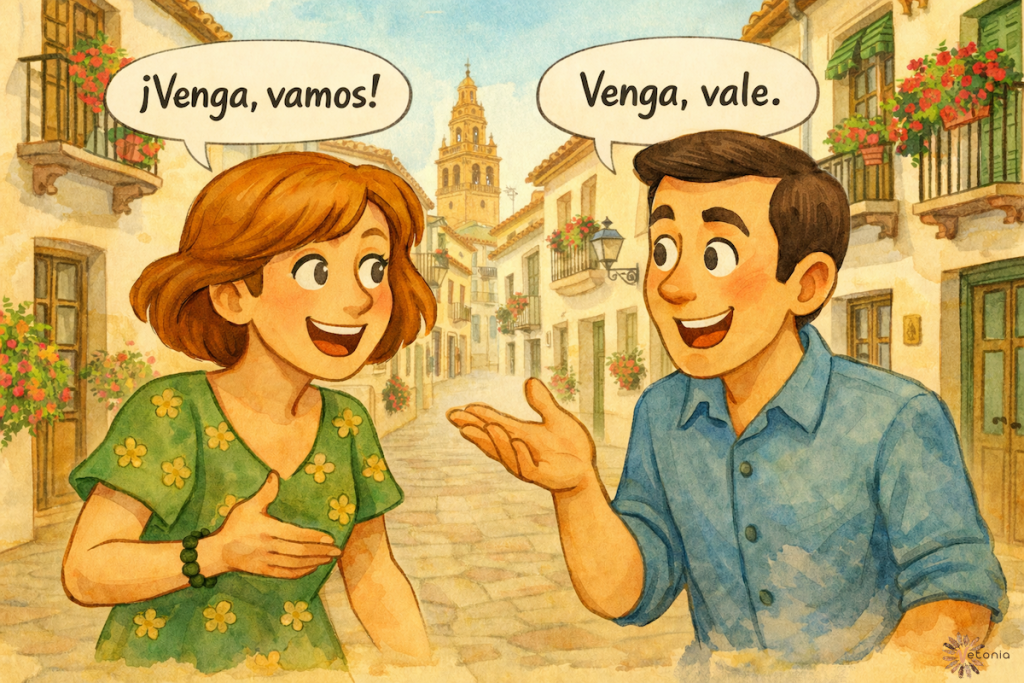
- —Dani: Venga, vale. Pero tú no corras.
- —Lucía: Venga, tranquilo, que llegamos.
- —Dani: Vale. Venga, vamos.
English:
- —Lucía: We’ve got ten minutes. Come on, put that in the backpack.
- —Dani: I’m coming, I’m coming.
- —Lucía: Alright, let’s see… keys, wallet, phone?
- —Dani: Yeah… well, the phone… wait.
- —Lucía: Oh, come on! You had it a second ago.
- —Dani: Here it is, here it is.
- —Lucía: Alright, down to it: we go downstairs and catch the metro.
- —Dani: Alright, fine. But don’t run.
- —Lucía: Okay, relax, we’ll make it.
- —Dani: Okay.Come on, let’s go.
Common Uses of Discourse Marker Venga
I’ve grouped the uses of venga by what they do in conversation.
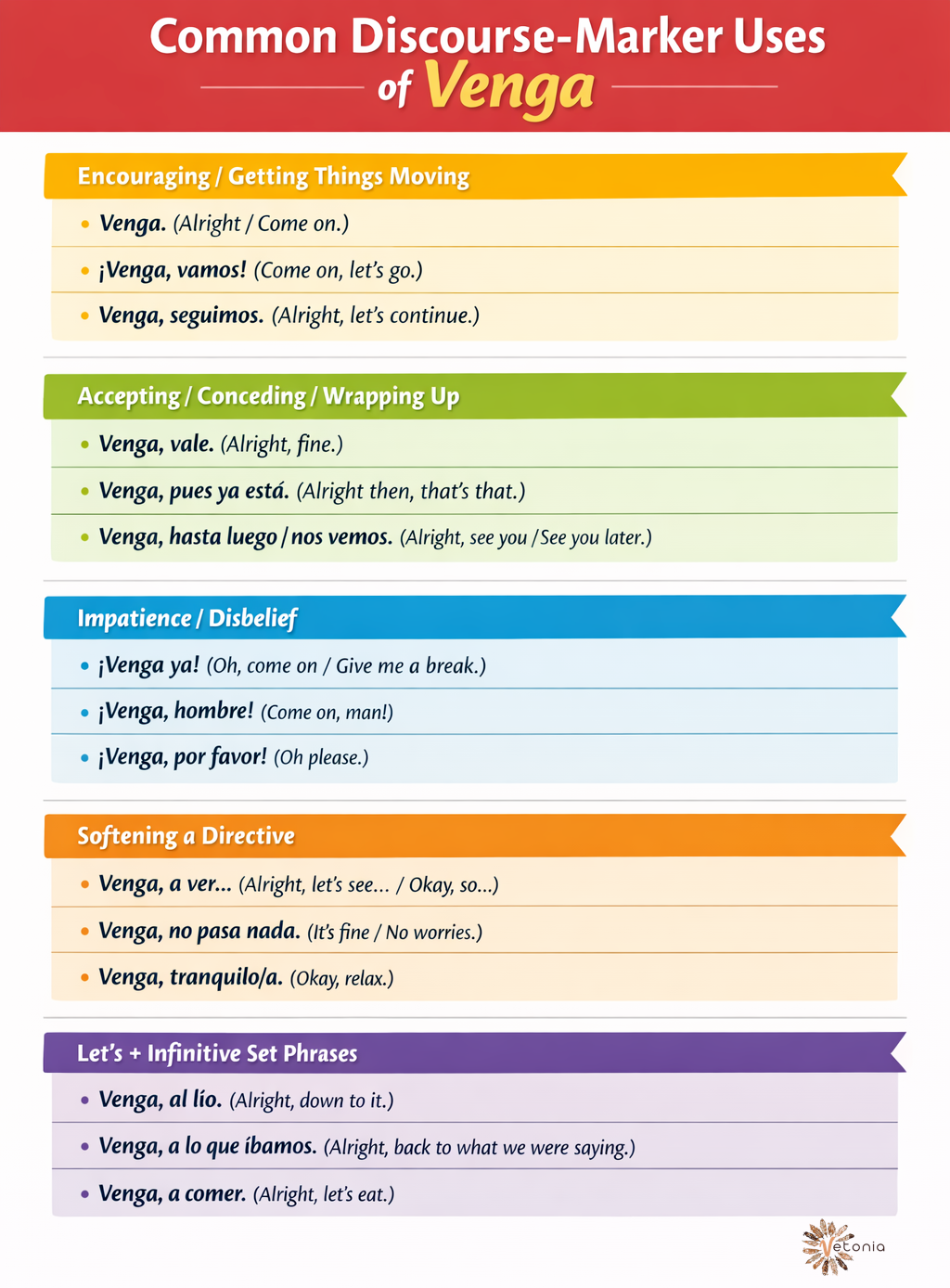
1) Encouraging / getting things moving
- Venga. (Alright / come on.)
- ¡Venga, vamos! (Come on, let’s go.)
- Venga, tira. (Go on, say it / do it.)
- Venga, anímate. (Come on, cheer up / give it a try.)
- Venga, seguimos. (Alright, let’s continue.)
2) Accepting / conceding / wrapping up
- Venga, vale. (Alright, fine.)
- Venga, de acuerdo. (Alright, agreed.)
- Venga, perfecto. (Great, sounds good.)
- Venga, hecho. (Done / it’s a deal.)
- Venga, pues ya está. (Alright then, that’s that.)
- Venga, hasta luego / nos vemos. (Alright, see you.)
3) “Enough already” / impatience / disbelief
- ¡Venga ya! (Oh come on / give me a break.)
- ¡Venga, hombre! (Come on, man! — classic)
- ¡Venga, por favor! (Oh please.)
- ¡Venga, no me digas! (Come on—no way!)
- ¡Venga, anda! (often like “oh come on” / “go on then,” depending on tone)
4) Reframing / softening a directive
- Venga, a ver… (Alright, let’s see… / Okay, so…)
- Venga, te cuento. (Alright, I’ll tell you.)
- Venga, no pasa nada. (Alright, it’s fine / no worries.)
- Venga, tranquilo/a. (Okay, relax.)
5) “Let’s + infinitive” set phrases
- Venga, a comer. (Alright, let’s eat.)
- Venga, a currar / a trabajar. (Alright, let’s work.)
- Venga, al lío. (Alright, down to it.)
- Venga, a lo que íbamos. (Alright, back to what we were saying.)
Stay tuned for part 2: ¡Vale! Spanish Discourse Markers…coming soon!
In the meantime, feel free to download this cheat sheet so you can practice anywhere. You can also explore online Spanish classes & immersive courses in Spain here.


0 Comments