El marcador discursivo anda es otra mina de oro en español, especialmente en España. Viene de andar (“caminar / ir”), pero en la conversación muchas veces funciona como una interjección / marcador pragmático: sorpresa, ánimo, incredulidad, suavizar algo, meter prisa, etc.
Ten en cuenta que aquí el tono importa muchísimo: ¡Anda! puede sonar encantado/a; ¡Anda ya! normalmente suena escéptico o molesto.
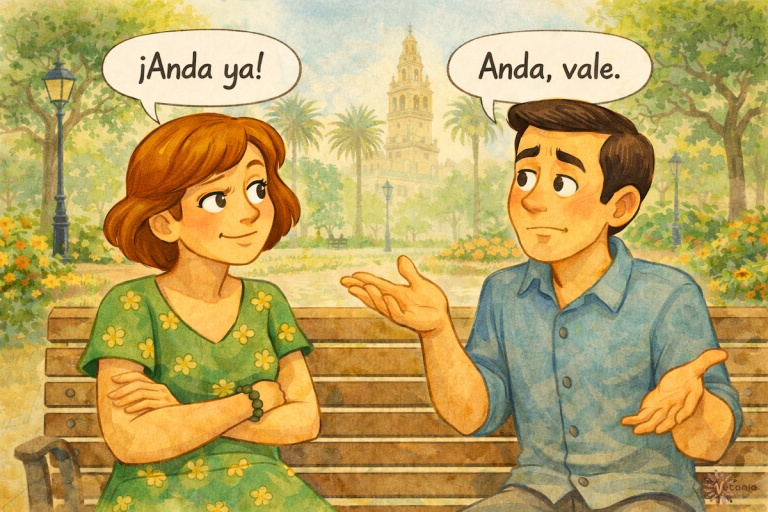
Ahora, aquí tienes un ejemplo de cómo puede sonar una conversación en español usando el marcador discursivo anda:
—María: ¿Has visto esto? Han cambiado el horario otra vez.
—Sergio: ¡Anda! ¿En serio?
—María: ¡Anda, mira! Ahora abre media hora más tarde.
—Sergio: ¡Anda ya! Pues genial…
—María: Bueno, anda, no pasa nada, nos tomamos un café mientras.
—Sergio: Ya, ya… anda, por favor, qué ganas.
—María: Anda, no exageres. Si estamos de paseo.
—Sergio: Vale, vale.
—María: Anda, vamos, que si no luego se llena.
—Sergio: Anda, vale. Pero tú eliges el sitio.
—María: Hecho. Anda, date prisa.
En inglés:
—María: Did you see this? They changed the schedule again.
—Sergio: No way! Seriously?
—María: Oh look! Now it opens half an hour later.
—Sergio: Oh, come on! Great…
—María: Well, it’s no big deal, we’ll grab a coffee while we wait.
—Sergio: Yeah, yeah… oh please, I’m thrilled.
—María: Come on, don’t exaggerate. We’re out for a walk.
—Sergio: Okay, okay.
—María: Come on, let’s go, or it’ll be packed later.
—Sergio: Alright, fine. But you pick the place.
—María: Deal. Come on, hurry up.
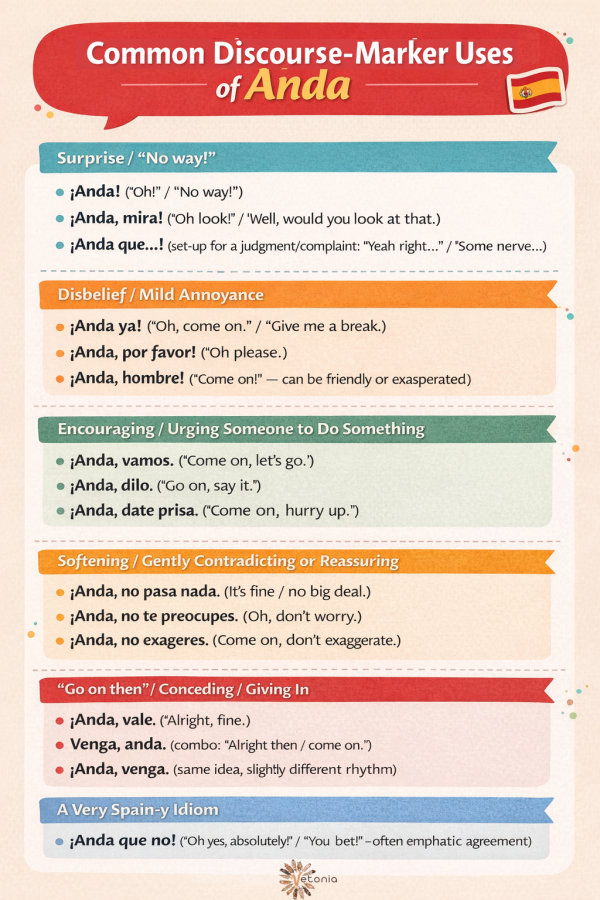
Aquí van marcadores comunes con anda, agrupados por “vibe” (o sea, por el tono/efecto que tienen):
Sorpresa / “¡No me digas!”
- ¡Anda! (Oh! / No way!)
- ¡Anda, mira! (Oh look! / Well, would you look at that.)
- ¡Anda que…! (set-up for a judgment/complaint: Yeah right… / Some nerve…)
Incredulidad / fastidio leve
- ¡Anda ya! (Oh, come on. / Give me a break.)
- ¡Anda, no me digas! (No way—really?)
- ¡Anda, por favor! (Oh please.)
- ¡Anda, hombre! (Come on! — can be friendly or exasperated)
Animar / empujar a alguien a hacer algo
- Anda, ven. (Come on, come here.)
- Anda, dilo. (Go on, say it.)
- Anda, pásame eso. (Here, pass me that. — softens the command)
- Anda, vamos. (Come on, let’s go.)
- Anda, date prisa. (Come on, hurry up.)
Suavizar / llevar la contraria con suavidad / tranquilizar
- Anda, no te preocupes. (Oh, don’t worry.)
- Anda, no pasa nada. (It’s fine / no big deal.)
- Anda, no exageres. (Come on, don’t exaggerate.)
Ceder / darse por vencido
- Anda, vale. (Alright, fine.)
- Venga, anda. (combo: Alright then / come on.)
- Anda, venga. (same idea, slightly different rhythm)
Una expresión muy de España:
- ¡Anda que no! (Oh yes, absolutely! / You bet! — often emphatic agreement)
Por cierto, el “¡Venga, vale, anda!” del título de este post viene a significar algo como: “Alright, okay then, come on!” (en ese tono de ir cerrando + dar un pequeño empujón para que la cosa avance).
Example Conversation with all Three Discourse-Markers
Here’s a taste of how a natural (not text-book) Spanish conversation using several discourse markers looks:
—Marta: ¿Entonces quedamos a las ocho?
—Álvaro: Vale, a las ocho. Pero en el bar de siempre, ¿eh?
—Marta: Venga, vale. (mira el móvil) Oye, me acaba de escribir Lucía: que llega tarde.
—Álvaro: ¡Anda ya! ¿Otra vez?
—Marta: Ya… vale, ya… lo típico.
—Álvaro: Venga, a ver, si llega tarde, pedimos algo y listo.
—Marta: Anda, pues sí. (sonríe) ¿Y tú has reservado?
—Álvaro: Venga, hombre, claro que he reservado.
—Marta: ¡Anda! ¿En serio? Pues mira qué bien.
—Álvaro: Venga, al lío: ¿te paso a buscar o nos vemos allí?
—Marta: Mejor nos vemos allí.
—Álvaro: Vale, perfecto. Y si Lucía protesta…ella paga por todos nosotros!
—Marta: Anda, que no! Jajaja. Venga, nos vemos luego.
—Álvaro: Vale, hasta luego.
Here’s what they’re saying in English:
—Marta: So, we’re meeting at eight?
—Álvaro: Okay, eight. But at our usual bar, yeah?
—Marta: Alright, fine. (checks her phone) Hey, Lucía just texted me—she’s going to be late.
—Álvaro: Oh, come on! Again?
—Marta: Yeah… okay, yeah… same old.
—Álvaro: Alright, let’s see—if she’s late, we’ll just order something and that’s it.
—Marta: Okay, sure. (smiles) And did you make a reservation?
—Álvaro: Come on, of course I booked it.
—Marta: No way! Seriously? Well, that’s great.
—Álvaro: Alright, down to business: do I pick you up or do we meet there?
—Marta: Better we meet there.
—Álvaro: Okay, perfect. And if Lucía complains…she pays for all of us!
—Marta: Yeah, right! Hahaha. Alright, see you later.
—Álvaro: Okay, see you.
Mientras tanto, si quieres, puedes descargarte esta chuleta para practicar donde sea. También puedes explorar aquí clases online de español y cursos de inmersión en España.